The History of the Bernedoodle: How This Unique Breed Came to Be
The Bernedoodle has become a popular companion for families looking for an affectionate, intelligent, and distinctive dog. With its fluffy coat, expressive face, and combination of Bernese Mountain Dog and Poodle characteristics, the Bernedoodle has an appearance that is easy to recognize.
But compared with established breeds such as the Bernese Mountain Dog and Poodle, the Bernedoodle has a relatively short history.
Understanding where the Bernedoodle came from requires looking at the history of both parent breeds, why breeders began combining them, and how the Bernedoodle developed into the companion dog families know today.
What Is a Bernedoodle?
A Bernedoodle is a cross between a Bernese Mountain Dog and a Poodle.
The goal of combining these breeds is to bring characteristics from both into one companion dog.
Bernese Mountain Dogs are known for their large size, affectionate personalities, striking tri-color markings, and history as Swiss farm dogs.
Poodles are known for their intelligence, athletic ability, distinctive coats, and long history as working and companion dogs.
The resulting Bernedoodle can inherit different combinations of characteristics from each parent.
This means Bernedoodles can vary in size, coat texture, coloring, energy level, and personality.
The Bernese Mountain Dog’s Swiss History
To understand the Bernedoodle, it helps to start with the Bernese Mountain Dog.
The Bernese Mountain Dog originated in Switzerland.
The breed was developed as a versatile farm dog, helping with tasks around farms and working alongside people.
These dogs were valued for their strength and ability to perform useful jobs.
Historically, Bernese Mountain Dogs could help drive livestock, pull carts, guard property, and perform other farm-related tasks.
Their strength and willingness to work made them valuable companions for Swiss farmers.
The breed’s distinctive tri-color appearance eventually became one of its most recognizable characteristics.
The Bernese Mountain Dog as a Family Companion
Although the Bernese Mountain Dog has working roots, it is also well known for its affectionate relationship with people.
Modern Bernese Mountain Dogs are commonly kept as family companions.
Their history of working closely with humans helps explain why many have a strong desire to remain near their families.
This people-oriented nature is one of the characteristics that attracted breeders and dog owners to the idea of creating a Bernese Mountain Dog and Poodle cross.
The History of the Poodle
The Poodle has an equally interesting history.
Despite the breed’s association with elegant grooming styles and dog shows today, Poodles have strong working roots.
The Poodle was developed as a water retriever.
Its coat and athletic abilities made it well suited for retrieving objects from water.
The breed became highly regarded for intelligence, trainability, and versatility.
Over time, Poodles became popular in different roles, including companion dogs and performance dogs.
Poodle Intelligence and Trainability
Poodles are widely recognized for their intelligence.
They can learn complicated behaviors and often enjoy activities that require mental engagement.
This characteristic is one reason Poodles have historically been successful in many different areas of dog work and competition.
When breeders began creating Bernedoodles, the Poodle’s intelligence and trainability were among the traits that made the cross appealing.
When Did the Bernedoodle First Appear?
Unlike the Bernese Mountain Dog and Poodle, the Bernedoodle does not have centuries of documented breed history.
The modern Bernedoodle emerged as a deliberate cross relatively recently.
SwissRidge Kennels is commonly associated with popularizing the Bernedoodle in the early 2000s.
The goal was to combine the Bernese Mountain Dog’s affectionate companion qualities with characteristics associated with the Poodle.
As interest grew, other breeders began developing their own Bernedoodle breeding programs.
The Bernedoodle quickly attracted attention among people interested in mixed-breed companion dogs.
Why Were Bernedoodles Created?
Different breeders may have different goals, but the general concept behind the Bernedoodle was to combine qualities associated with both parent breeds.
The Bernese Mountain Dog contributes characteristics such as its affectionate nature, sturdy build, and recognizable coloring.
The Poodle contributes intelligence, athleticism, and a coat that can vary considerably depending on genetics.
The resulting cross can produce dogs with a fascinating combination of traits.
However, genetics do not work like a simple checklist.
A Bernedoodle cannot be guaranteed to inherit every desired characteristic from both parents.
Bernedoodle Coat Types
One of the most noticeable areas of variation among Bernedoodles is the coat.
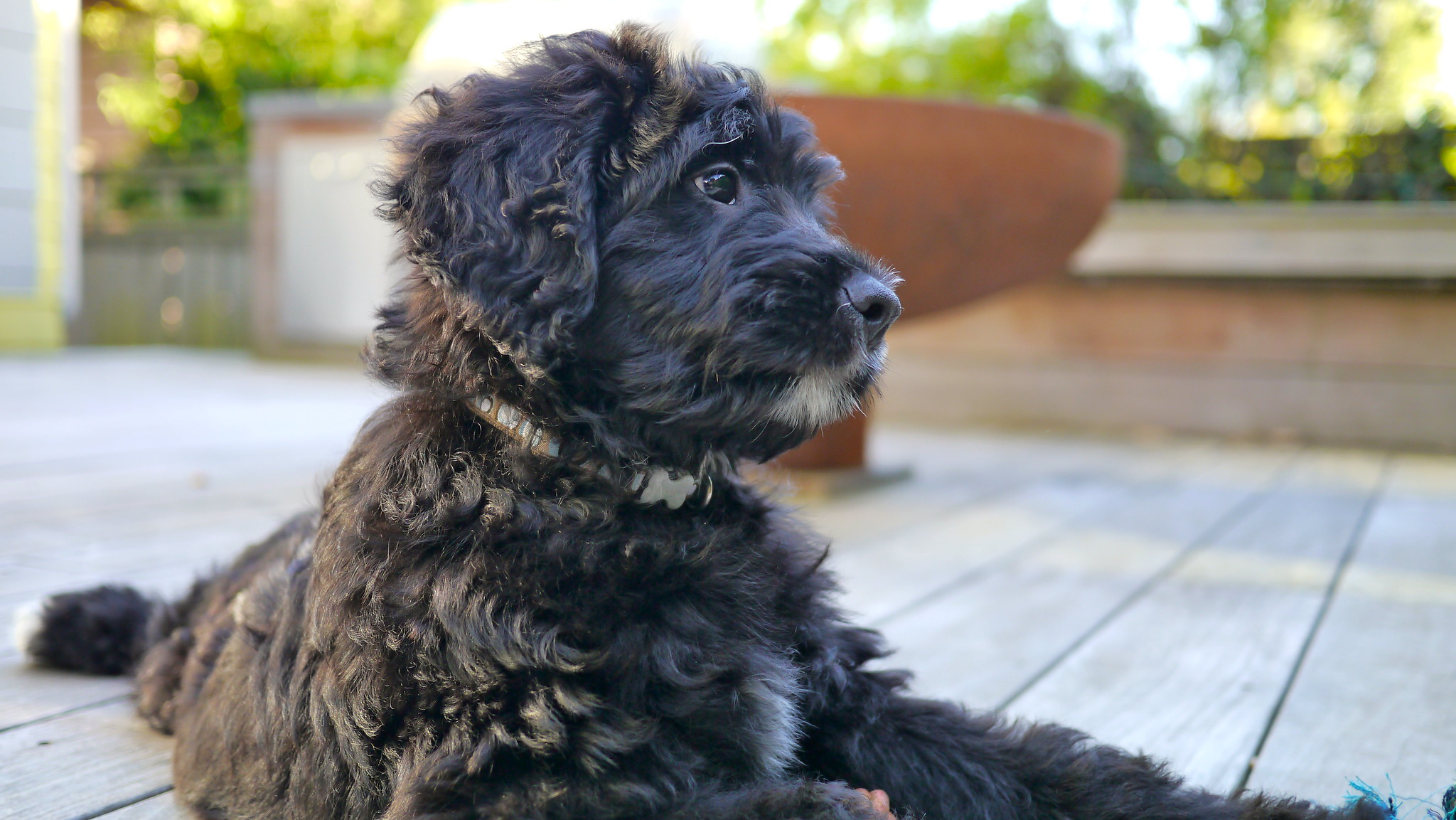
Depending on genetics, a Bernedoodle can have a coat that is straighter, wavier, or curlier.
This variation comes from the different coat characteristics present in the parent breeds and the specific genetics inherited by an individual puppy.
Coat type is important for owners because it can influence grooming requirements.
A curlier or longer coat may require significantly more brushing and professional grooming than a shorter or straighter coat.
Bernedoodle Colors and Markings
Many people are initially attracted to Bernedoodles because of their beautiful coloring.
Some have the classic tri-color appearance associated with the Bernese Mountain Dog.
Others may display different combinations of black, white, brown, or other colors depending on their genetics.
Color and markings can vary considerably.
The appearance of an individual puppy should therefore be considered separately from assumptions about personality or behavior.
A particular coat color does not automatically determine how a Bernedoodle will behave.
Different Bernedoodle Generations
As Bernedoodles became more popular, breeders developed different generations and breeding combinations.
You may encounter terms such as:
F1 Bernedoodle
F1B Bernedoodle
F2 Bernedoodle
Reverse F1B Bernedoodle
These labels describe how the dog was bred.
An F1 Bernedoodle is generally the result of breeding a Bernese Mountain Dog with a Poodle.
An F1B involves breeding an F1 Bernedoodle back to one of the parent breeds.
A reverse F1B generally involves breeding an F1 Bernedoodle back toward the Bernese Mountain Dog side.
Understanding these terms can help prospective owners understand why Bernedoodles can differ significantly in appearance and coat characteristics.
What Is a Reverse F1B Bernedoodle?
A reverse F1B Bernedoodle is bred by taking an F1 Bernedoodle and breeding it back to a Bernese Mountain Dog.
This produces a dog with a higher percentage of Bernese Mountain Dog genetics than a standard F1B bred back toward the Poodle.
Montana Berners specializes in Reverse F1B Bernedoodles, describing them as approximately 75% Bernese Mountain Dog and 25% Standard Poodle.
This breeding approach is particularly relevant for families researching Montana Berners because it helps explain the type of Bernedoodle the program focuses on.
Why Breeding Generations Matter
Understanding generations can help families ask better questions when researching Bernedoodle puppies.
Different generations can produce different expectations regarding:
Coat characteristics
Shedding
Size
Appearance
Personality
Grooming requirements
However, generation labels do not eliminate genetic variation.
Even puppies from the same generation can develop differently.
Prospective owners should therefore ask breeders about the actual parent dogs and the characteristics they are selecting for rather than relying only on an F1 or F1B label.
The Bernedoodle Is Still a Relatively Young Cross
The Bernedoodle has not been around nearly as long as its parent breeds.
This is important when discussing its history.
The Bernese Mountain Dog has a long-established historical background.
The Poodle has an extensive working and cultural history.
The Bernedoodle, by comparison, is a relatively modern creation.
Its development is closely connected to the growing interest in intentionally bred companion crosses during the late twentieth and early twenty-first centuries.
Bernedoodles and the Rise of Designer Crosses
The Bernedoodle emerged during a period when many intentional dog crosses became increasingly popular.
Breeders and families became interested in combining characteristics from established breeds.
Examples include Labradoodles, Goldendoodles, Cockapoos, and other Poodle crosses.
The Bernedoodle followed a similar concept but used the Bernese Mountain Dog as the other parent.
Its distinctive coloring and affectionate reputation helped it stand out.
Why Families Became Interested in Bernedoodles
Bernedoodles appeal to many families for several reasons.
Their appearance is distinctive.
Their parent breeds have long histories of working alongside people.
They can be highly intelligent.
Many enjoy spending significant amounts of time with their families.
They can also be versatile companions when given appropriate training, exercise, and socialization.
However, prospective owners should avoid assuming that every Bernedoodle will have exactly the same personality.
The individual dog’s genetics and upbringing matter.
Bernedoodles Today
Today, Bernedoodles can be found in many different sizes and coat types.
They are commonly raised as family companions and can participate in a wide variety of activities.
Some enjoy hiking.
Others prefer relaxed family life.
Some are highly motivated by training.
Others are more interested in playing and spending time beside their owners.
This versatility is part of the breed’s appeal.
The Importance of Responsible Bernedoodle Breeding
As interest in Bernedoodles has grown, responsible breeding has become increasingly important.
Breeders should consider more than producing puppies with attractive coats.
Health, temperament, structure, genetics, and the suitability of parent dogs should all be considered.
Prospective owners should ask breeders questions about the parents, health testing, veterinary care, socialization, and the environment in which puppies are raised.
A responsible breeder should also care about where puppies are placed and whether a particular family is a good match.
Why Health History Matters
A puppy’s parents can provide valuable information about the health and characteristics that may be passed to future generations.
Prospective owners should ask what health screening has been performed on the parent dogs.
They should also receive appropriate veterinary documentation for the puppy.
No breeder can guarantee that a dog will never develop a health problem.
However, responsible breeding practices can help reduce avoidable risks and improve the quality of future generations.
Bernedoodle History Helps Explain the Modern Dog
Understanding the breed’s history makes it easier to understand why Bernedoodles can be so diverse.
Their Bernese Mountain Dog ancestry helps explain their sturdy appearance and many of the personality traits associated with close family companionship.
Their Poodle ancestry helps explain their intelligence, athletic ability, and coat variation.
The combination creates a dog that can be affectionate, smart, playful, and visually distinctive.
But the Bernedoodle should not be viewed as simply “half Bernese Mountain Dog and half Poodle” in every case.
Different generations can have significantly different genetic percentages.
A Young Cross With a Growing Future
The Bernedoodle’s story is still being written.
Unlike breeds with hundreds of years of established history, the modern Bernedoodle is relatively new.
Breeders, owners, trainers, veterinarians, and dog enthusiasts continue learning more about the characteristics of these crosses as generations develop.
That makes responsible breeding and informed ownership particularly important.
Families considering a Bernedoodle should look beyond appearance and learn about the dogs behind the puppy.
What Prospective Owners Should Learn
Before bringing home a Bernedoodle, families should understand several basic facts.
First, Bernedoodles can vary significantly in size and appearance.
Second, coat type affects grooming requirements.
Third, temperament can vary from dog to dog.
Fourth, training and socialization remain important regardless of generation.
Finally, responsible breeding practices matter.
Learning these details before choosing a puppy can help families make better decisions.
Final Thoughts on the History of the Bernedoodle
The Bernedoodle may be a relatively modern cross, but its history connects two dogs with fascinating backgrounds.
The Bernese Mountain Dog brings centuries of Swiss working-dog history, strength, loyalty, and companionship.
The Poodle contributes a long history of retrieving, intelligence, athleticism, and versatility.
The modern Bernedoodle combines elements of these two backgrounds into a companion dog that has become increasingly popular with families.
As interest in Bernedoodles continues to grow, understanding their origins can help owners appreciate more than just their appearance.
Every Bernedoodle represents a combination of genetics, breeding decisions, upbringing, training, and individual personality.
For families considering one of these dogs, learning the history behind the Bernedoodle is an excellent first step toward understanding the companion they may eventually bring home.
Read Next: Bernedoodle Feeding Guide: How to Build a Healthy Mealtime Routine