
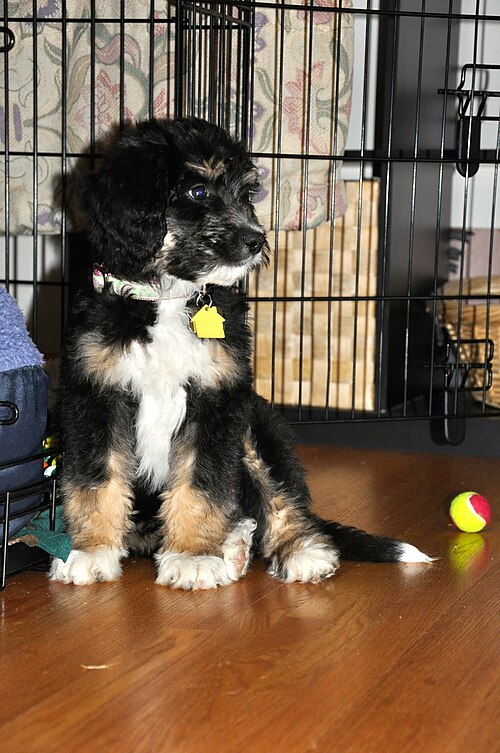
Bernedoodle Puppy Training Guide: Building Good Habits From the Start
Bringing home a Bernedoodle puppy is an exciting experience, but the first few weeks also provide an important opportunity to establish habits that can shape the dog’s behavior for years to come. Bernedoodles are intelligent, people-oriented dogs that can learn quickly when training is consistent, positive, and age-appropriate.
A successful training routine is about more than teaching a puppy to sit or stay. It includes house training, crate training, socialization, leash skills, bite inhibition, recall, calm behavior, and learning how to live comfortably within a family’s daily routine.
Because Bernedoodles can grow into large dogs, teaching good manners while they are young can make everyday life much easier later. A puppy that learns not to jump on people at 15 pounds may be much easier to manage when that same dog becomes a large adult.
The key is to start with realistic expectations and build one skill at a time.
Start Training Your Bernedoodle Puppy Early
Bernedoodle training can begin as soon as a puppy comes home.
Early training does not mean expecting a very young puppy to master complicated obedience commands. Instead, the first goal should be teaching the puppy that listening to people, exploring new experiences, and responding to rewards are positive experiences.
Simple behaviors can become the foundation for more advanced training.
Say the puppy’s name and reward the puppy for looking toward you.
Reward calm behavior.
Practice short periods of following you around the house.
Introduce simple commands such as sit.
Reward the puppy for coming when called in a safe environment.
These exercises may seem basic, but they teach the puppy how to learn.
Use Positive Reinforcement
Positive reinforcement is one of the most useful approaches for Bernedoodle puppy training.
When a puppy performs a behavior you want, immediately reward it with something motivating. Depending on the puppy, this could be a small food reward, praise, affection, play, or access to something the puppy enjoys.
Timing matters.
If you want to reward your puppy for sitting, deliver the reward while the puppy is sitting or immediately afterward. This helps the puppy connect the behavior with the positive outcome.
The goal is to make good choices rewarding.
Punishing a puppy after it has already forgotten what it did is unlikely to teach the desired behavior. Instead, owners can focus on preventing unwanted behavior when possible and rewarding the behavior they want to see more often.
Teach Your Bernedoodle Its Name
One of the simplest early exercises is name recognition.
Say your Bernedoodle puppy’s name in a happy voice.
When the puppy looks at you, offer a reward.
Repeat this several times throughout the day in short sessions.
Avoid constantly saying the puppy’s name when you are frustrated or when something unpleasant is about to happen.
The puppy should learn that hearing its name means paying attention to its person.
Once the puppy reliably looks at you when its name is spoken, owners can begin using the behavior in other training exercises.
House Training a Bernedoodle Puppy
House training is one of the biggest priorities for a new puppy owner.
Young puppies have limited bladder control, so accidents are normal during the learning process.
The most effective approach is to create a predictable routine.
Take the puppy outside after waking up.
Take the puppy outside after eating.
Take the puppy outside after drinking a significant amount of water.
Take the puppy outside after active play.
Take the puppy outside before bedtime.
Young puppies may also need additional potty breaks throughout the day.
When the puppy eliminates in the correct location, provide immediate praise and reinforcement.
Consistency is important because puppies learn through repetition.
Watch for Potty Training Signals
Owners can make house training easier by learning their puppy’s individual signals.
Some puppies sniff the floor.
Others circle, wander away from the family, whine, or suddenly stop playing.
When you notice these behaviors, calmly take the puppy outside.
The more often an owner prevents an accident and rewards the correct behavior, the faster the puppy can understand the routine.
If an accident happens indoors, avoid harsh punishment.
Clean the area thoroughly so lingering odors do not encourage the puppy to return to the same location.
Crate Training a Bernedoodle
A crate can be a useful training and management tool when introduced properly.
The crate should become a comfortable place rather than a punishment.
Start by allowing the puppy to explore it voluntarily.
Place comfortable bedding inside if appropriate and offer safe treats or toys.
Keep the door open initially.
Once the puppy is comfortable entering the crate, owners can begin closing the door for very short periods while remaining nearby.
Gradually increase the amount of time.
The process should move at the puppy’s pace.
A puppy that immediately experiences long periods of confinement may begin associating the crate with isolation.
A puppy that learns the crate is a safe resting space may eventually choose to relax there voluntarily.
Don’t Use the Crate as Punishment
If a Bernedoodle puppy is sent to its crate every time it misbehaves, the puppy may begin viewing the crate negatively.
Instead, use the crate as a calm management tool.
If the puppy is overtired and needs a nap, the crate can provide a quiet place to rest.
If the owner needs to temporarily prevent destructive chewing, the crate can provide a safe environment when used appropriately.
The overall goal should be for the puppy to associate the crate with comfort and relaxation.
Teaching Your Bernedoodle to Come When Called
Recall is one of the most important commands a dog can learn.
A reliable recall can help protect a dog if it accidentally gets loose or encounters a potentially dangerous situation.
Start in a controlled environment.
Use a happy voice.
Move away from the puppy.
Say the puppy’s name followed by a recall command.
When the puppy comes to you, reward generously.
Make coming to you worthwhile.
One important rule is to avoid repeatedly calling the puppy for unpleasant experiences. If “come” always means the end of play, a bath, or something the puppy dislikes, the command may become less exciting.
Practice recall during enjoyable situations as well.
Teach Loose-Leash Walking
A Bernedoodle puppy may be small enough to physically manage at first, but that will not always be the case.
Teaching leash manners early is therefore extremely valuable.
Start in a quiet environment where there are few distractions.
Reward the puppy for walking near you without pulling.
If the puppy pulls toward something, avoid turning the pulling into a game of tug-of-war. Instead, stop, redirect the puppy, and reward the desired behavior when attention returns to you.
Over time, gradually practice in more distracting environments.
The goal is not simply to make the puppy walk beside you perfectly. The goal is to teach the puppy that staying connected to its handler makes good things happen.
Teach Bite Inhibition
Puppies naturally explore their world with their mouths.
Play biting is common, especially during teething.
However, puppies should gradually learn that human skin is not an appropriate chew toy.
If a puppy becomes overly rough during play, calmly redirect it toward an appropriate toy.
Avoid encouraging rough hand wrestling if you do not want the behavior to continue as the puppy grows.
Providing suitable chew toys can also give the puppy an appropriate outlet for normal chewing behavior.
Consistency among everyone in the household is important.
If one family member encourages biting hands while another tries to stop it, the puppy receives conflicting information.
Teach Your Bernedoodle Not to Jump
Bernedoodles are affectionate dogs, and many puppies become excited when people enter the home.
A tiny puppy jumping against someone’s legs may seem harmless.
A large adult dog doing the same thing can be a different story.
Begin teaching polite greetings early.
Reward the puppy when all four paws are on the floor.
Ask visitors to avoid rewarding jumping with attention.
If the puppy jumps, calmly wait for the behavior to stop and reward the calmer behavior.
With repetition, the puppy can learn that calm greetings receive attention.
Teach Calmness, Not Just Commands
One of the most overlooked parts of puppy training is teaching a dog how to relax.
Owners sometimes focus heavily on physical exercise and obedience commands while forgetting that puppies need to learn how to settle.
Reward your Bernedoodle when it lies quietly near you.
Give the puppy a safe chew while it relaxes.
Practice short periods where nothing exciting happens.
This can help teach the puppy that it does not need constant entertainment.
A dog that learns how to settle can be much easier to live with.
Socialization Is Different From Meeting Everyone
Socialization is an important part of raising a confident Bernedoodle.
However, socialization does not mean forcing a puppy to interact with every person or dog it encounters.
Instead, puppies should gradually experience different sights, sounds, environments, surfaces, and situations in positive ways.
A puppy might experience:
Different types of flooring
Household appliances
Car rides
New people
Calm, appropriate dogs
Outdoor environments
Grooming equipment
Veterinary handling
Different sounds
Collar and leash handling
The puppy should be allowed to process new experiences without becoming overwhelmed.
Positive experiences can help a young dog become more comfortable with the world around it.
Make Grooming Part of Puppy Training
Grooming should be introduced as part of training rather than treated as a separate activity.
Bernedoodles can have coats that require regular maintenance, so puppies should learn that being brushed and handled is normal.
Gently touch the puppy’s paws.
Handle the ears.
Look at the teeth.
Brush small sections of the coat.
Reward calm cooperation.
Keep early sessions short.
These habits can make future grooming appointments considerably easier.
Keep Training Sessions Short
Young puppies have limited attention spans.
Long training sessions can quickly become frustrating.
Instead, practice for a few minutes at a time.
You can repeat training throughout the day during normal activities.
Before putting down a food bowl, practice a sit.
Before opening a door, practice waiting.
During play, practice recall.
During grooming, reward calm behavior.
This approach allows training to become part of everyday life rather than something that only happens during a formal session.
Avoid Expecting Too Much Too Soon
Bernedoodle puppies are still developing physically and mentally.
A puppy that struggles with a command today may understand it much better after additional practice.
Training should be based on gradual progress.
One day may feel like a major success, while the next may seem like the puppy has forgotten everything.
This is normal.
Consistency is more important than perfection.
Instead of becoming frustrated when a puppy makes a mistake, go back to an easier version of the exercise and build up again.
Use the Environment to Prevent Problems
Training is not only about correcting behavior after it happens.
Good puppy owners also manage the environment to prevent unwanted behavior.
If a puppy repeatedly steals shoes, keep shoes out of reach.
If the puppy chews electrical cords, block access.
If the puppy gets into trash, secure the trash can.
If certain areas of the home are unsafe, use appropriate barriers.
Every time a puppy practices an unwanted behavior, it becomes more familiar.
Preventing opportunities for destructive behavior while teaching alternatives can make training much easier.
Mental Stimulation for a Bernedoodle Puppy
Bernedoodles can benefit from activities that challenge their minds.
Training itself is mental stimulation.
Puzzle toys, supervised scent games, food-based enrichment, and learning new tricks can also provide appropriate challenges.
The goal is not to exhaust a puppy through endless activity.
Young puppies need plenty of rest.
A balanced routine should include sleep, play, training, exploration, meals, and quiet time.
Consistency Between Family Members Matters
A Bernedoodle puppy should not have completely different rules depending on who is holding the leash.
If one person allows jumping while another discourages it, the puppy receives mixed signals.
Families should agree on basic expectations.
Decide where the puppy is allowed to sleep.
Decide which furniture is allowed.
Use consistent command words.
Agree on how jumping will be handled.
Agree on which behaviors receive rewards.
Consistency makes learning easier.
When Bernedoodle Training Becomes Difficult
Some puppies will learn certain behaviors more quickly than others.
If a puppy continues to struggle with house training, aggression, severe fear, destructive behavior, or other concerning issues, owners should seek help from a qualified professional.
Veterinary guidance can also be appropriate when behavior changes suddenly or appears connected to pain, illness, or another underlying problem.
There is no benefit in waiting until a small training problem becomes a major one.
Early professional guidance can often make the process easier for both the dog and the owner.
Final Thoughts on Training a Bernedoodle Puppy
Training a Bernedoodle puppy is a long-term process rather than a one-week project.
The first months provide an excellent opportunity to establish habits that can continue throughout the dog’s life. House training, crate training, recall, leash manners, bite inhibition, grooming tolerance, socialization, and calm behavior all contribute to a well-mannered companion.
The most effective approach is usually patient, consistent, and positive.
Keep sessions short.
Reward the behaviors you want.
Prevent opportunities for unwanted behavior.
Give the puppy time to mature.
And remember that progress is rarely perfectly linear.
A Bernedoodle does not need to be a perfect puppy to be a successful one. With consistent guidance and plenty of positive experiences, a young Bernedoodle can gradually develop into the confident, well-mannered family companion its owners hoped for.
Focus Keyphrase: Bernedoodle puppy training
SEO Title: Bernedoodle Puppy Training Guide: Tips for New Owners
Meta Description: Learn how to train a Bernedoodle puppy with practical tips for house training, crate training, recall, leash manners, socialization, biting, jumping, and calm behavior.
Read Next: How to Groom a Bernedoodle: Brushing, Bathing, Coat Care and Grooming Tips