
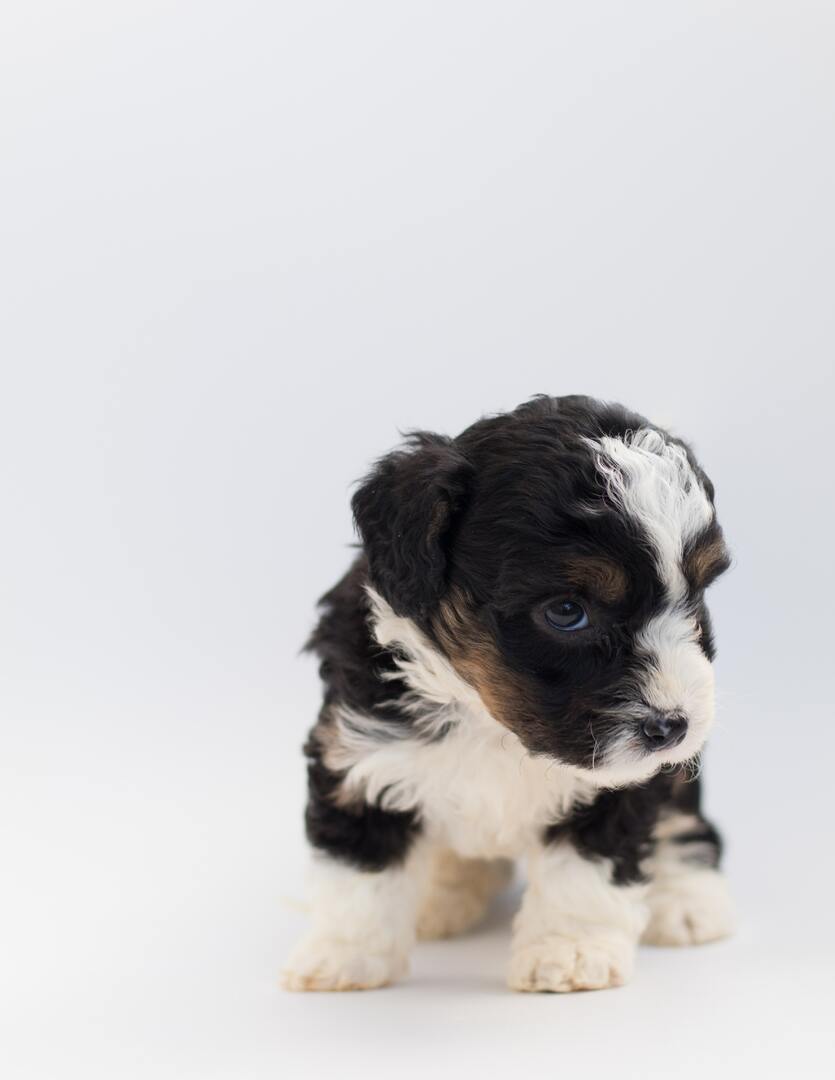
Bernedoodle Puppy Growth Stages: What to Expect From Puppyhood to Adulthood
Watching a Bernedoodle puppy grow is one of the most rewarding parts of owning one. A puppy that starts out small can seem to change almost every week during the first several months, developing new physical abilities, behaviors, and personality traits along the way.
Understanding Bernedoodle growth stages can help owners know what changes are normal, what training priorities to focus on, and how to adjust care as the puppy matures.
Bernedoodles can vary considerably in size because their adult size depends on genetics and the specific dogs involved in the breeding program. Montana Berners raises Reverse F1B Bernedoodles, which the breeder describes as approximately 75% Bernese Mountain Dog and 25% Standard Poodle. This means families should focus on the individual puppy’s expected growth rather than assuming every Bernedoodle will reach the same size.
Growth is also more than getting taller and heavier. Puppies are developing coordination, confidence, social skills, independence, and the ability to understand their environment.
Bernedoodle Growth Is Not the Same for Every Puppy
One of the most important things to understand is that there is no single growth chart that perfectly predicts every Bernedoodle.
Genetics play a major role in determining adult size.
Other factors can influence development as well, including nutrition, health, activity, and overall environment.
Two puppies can be the same age and look noticeably different.
One may have longer legs.
Another may have a thicker body.
One may mature physically faster while another continues filling out later.
This variation is normal.
Rather than comparing a Bernedoodle puppy to pictures of other dogs online, owners should monitor their own puppy’s growth and maintain regular veterinary checkups.
The First Weeks of a Bernedoodle’s Life
Much of a puppy’s earliest development happens before it goes to its new home.
During the first weeks of life, puppies spend much of their time sleeping, eating, and developing physically.
Their senses gradually become more developed, and they begin interacting more actively with their mother and littermates.
Early experiences during this period can contribute to future behavior.
Responsible breeding programs provide puppies with appropriate care, nutrition, handling, and early experiences before they leave for their new families.
By the time a Bernedoodle puppy arrives home, it has already passed through an important portion of its early developmental journey.
Bringing Home a Bernedoodle Puppy
The transition to a new home is a major event for a puppy.
Everything is different.
The puppy has new people, new smells, new sounds, new sleeping arrangements, and a different daily routine.
During the first days, owners should focus on creating stability rather than overwhelming the puppy with constant activities.
Give the puppy a safe place to rest.
Maintain a consistent feeding routine.
Provide frequent potty opportunities.
Use short training sessions.
Allow plenty of sleep.
Gradually introduce the puppy to the household.
The goal is to help the puppy understand that its new home is safe and predictable.
The Young Puppy Stage
Young Bernedoodle puppies spend a significant amount of time sleeping.
They also begin developing stronger curiosity about the world around them.
This is a great time to introduce basic household routines.
Puppies can begin learning:
Their name
Where to potty
Basic crate skills
Appropriate chewing
Gentle handling
Simple commands
Calm greetings
Leash introduction
Grooming routines
Training should remain short and positive.
A puppy’s attention span is limited, so several brief sessions can be more productive than one long lesson.
Socialization During Puppyhood
Puppyhood is an important time for positive social experiences.
Socialization involves helping a puppy become comfortable with different people, sounds, environments, surfaces, and everyday situations.
This does not mean forcing a puppy into every possible situation.
Instead, owners should introduce experiences gradually.
For example, a puppy might calmly meet a new person one day and explore a new part of the house another day.
The goal is to help the puppy learn how to process unfamiliar experiences.
Owners should follow veterinary guidance regarding vaccinations and appropriate public exposure.
The Teething Stage
As Bernedoodle puppies mature, teething becomes a major part of daily life.
Puppies naturally want to chew.
Chewing can provide relief during teething while also helping puppies explore their surroundings.
Instead of trying to eliminate chewing, owners should redirect it toward appropriate puppy-safe toys and chews.
Keep valuable household objects out of reach.
If the puppy repeatedly chooses shoes or furniture, management is important.
Prevent access and provide an acceptable alternative.
The goal is to teach the puppy what it is allowed to chew.
Growing Into a More Independent Puppy
As a Bernedoodle matures, owners may notice the puppy becoming more confident and curious.
The dog may begin exploring farther from its owner.
It may become more interested in the environment.
It may also test boundaries.
This is a normal part of development.
Continue reinforcing previously learned behaviors.
Do not assume that because the puppy learned something once, training is finished.
Repetition helps turn behaviors into habits.
Adolescence Can Bring New Challenges
Bernedoodles do not remain tiny puppies forever.
As they approach adolescence, owners may notice changes in behavior.
A puppy that previously responded immediately to a command may suddenly become distracted.
A dog that stayed close in the yard may become more interested in exploring.
Some puppies become more energetic or independent.
This can be frustrating for owners, but it does not necessarily mean training has failed.
Adolescence is a developmental stage.
Continue using consistent expectations and positive reinforcement.
Return to simpler versions of commands when necessary and gradually rebuild reliability.
Continue Socialization as Your Bernedoodle Grows
Socialization should not stop once puppyhood becomes less demanding.
A growing Bernedoodle should continue having positive experiences with different environments.
Take the dog on appropriate outings.
Practice calm behavior around visitors.
Continue handling exercises.
Expose the dog to normal household activities.
Practice walking in different environments.
The goal is to develop a dog that can remain comfortable and responsive as its world becomes larger.
Bernedoodle Growth and Exercise
Exercise needs change as a puppy grows.
Young puppies should receive age-appropriate activity with plenty of rest.
As the dog matures, owners can gradually increase structured activity.
Avoid treating a young Bernedoodle like an adult athlete.
Long runs, repetitive high-impact exercise, and demanding hikes may not be appropriate for a growing puppy.
Instead, focus on short walks, supervised play, training, exploration, and mental enrichment.
Your veterinarian can help determine an appropriate exercise routine for your individual puppy.
Nutrition Changes During Growth
Feeding requirements also change as a Bernedoodle grows.
A young puppy requires food formulated for growth.
As the dog approaches adulthood, the feeding plan may eventually need to change.
Owners should not simply continue increasing the amount of food every time the puppy appears hungry.
Monitor body condition and growth with veterinary guidance.
For larger Bernedoodles, appropriate nutrition during development is especially important.
Avoid adding calcium or other supplements unless your veterinarian recommends them.
More nutrients are not automatically better.
Balanced nutrition is the goal.
Tracking Your Bernedoodle’s Weight
Regular weight checks can provide useful information about growth.
Owners can keep a simple record of their dog’s weight over time.
Veterinary visits provide another opportunity to monitor development.
The important thing is to look at the overall trend rather than becoming concerned about one individual number.
A puppy’s weight can naturally fluctuate as it grows.
If growth appears unusually slow or rapid, discuss it with your veterinarian.
Coat Changes During Growth
A Bernedoodle’s coat can change significantly as the dog matures.
The puppy coat may not look exactly like the adult coat.
Texture, curl, density, and shedding characteristics can become more noticeable over time.
This is another reason grooming should begin early.
Even when the puppy’s coat is relatively easy to maintain, regular brushing and handling can help prepare the dog for future grooming requirements.
As the adult coat develops, owners may need to adjust brushing frequency and professional grooming schedules.
Grooming During the Growth Stages
Bernedoodle owners should treat grooming as an ongoing part of development.
Young puppies should become comfortable with:
Brushing
Paw handling
Ear handling
Tooth brushing
Nail care
Bathing
Being handled around the face
Short, positive sessions can help create good habits.
As the coat becomes longer and more developed, owners may need to spend more time maintaining it.
Waiting until the adult coat is heavily tangled before establishing a grooming routine can create unnecessary difficulties.
The Importance of Sleep During Growth
Sleep is often overlooked when owners think about puppy development.
Growing puppies need substantial rest.
A puppy that has been playing, training, exploring, and interacting with people may suddenly need a long nap.
Allowing adequate sleep helps prevent owners from interpreting normal puppy fatigue as a behavioral problem.
If a puppy becomes unusually difficult, mouthy, frantic, or unable to settle, consider whether it may simply be overtired.
A quiet sleeping area can help.
Mental Development Is Just as Important as Physical Growth
A Bernedoodle’s body is only one part of development.
The puppy is also learning how the world works.
It is learning which behaviors receive rewards.
It is learning how to communicate.
It is learning how to respond to people.
It is learning how to handle new experiences.
Training, puzzle toys, scent games, and controlled exploration can support this mental development.
There is no need to constantly challenge a puppy with complicated activities.
Simple experiences repeated consistently can be extremely valuable.
Don’t Rush Your Bernedoodle’s Development
Every puppy develops at its own pace.
Some may appear mature early.
Others remain playful and puppy-like for longer.
Avoid comparing your dog too closely with other Bernedoodles.
A puppy that is slower to master a command is not necessarily behind.
Likewise, a puppy that is physically larger is not necessarily more mature behaviorally.
Physical growth and emotional development do not always happen at the same speed.
Preparing for the Adult Bernedoodle
As your puppy gets older, begin thinking about the adult lifestyle you want to provide.
If you want a dog that walks calmly, continue leash training.
If you want a dog that can relax around visitors, reward calm greetings.
If you want a dog that cooperates during grooming, continue handling exercises.
If you want a dog that responds when called, practice recall regularly.
The adult dog you live with is influenced by the habits established during puppyhood.
What Happens When a Bernedoodle Reaches Adulthood?
Eventually, the rapid puppy growth begins to slow.
The dog becomes physically more mature.
Its personality may become more predictable.
Training becomes less about managing a young puppy and more about maintaining reliable behavior.
Adult Bernedoodles can continue learning throughout their lives.
They may enjoy advanced obedience, scent work, hiking, retrieving games, tricks, and other activities depending on their interests and physical abilities.
Growing up does not mean learning stops.
When to Talk With Your Veterinarian
Regular veterinary care is an important part of monitoring Bernedoodle development.
Contact your veterinarian if you notice concerns such as:
Sudden weight loss
Unusual weight gain
Persistent digestive problems
Lack of appetite
Significant lethargy
Persistent lameness
Difficulty moving
Changes in behavior
Developmental concerns
Owners should not rely solely on internet growth charts to determine whether a puppy is healthy.
A veterinarian can evaluate the individual puppy’s physical development and provide personalized recommendations.
Enjoy Each Stage
It can be tempting to wish for a puppy to become perfectly trained and mature quickly.
But each stage has something special.
The tiny puppy stage eventually disappears.
The awkward adolescent stage passes.
The energetic young dog becomes an adult.
Taking photographs, keeping weight records, and documenting milestones can help owners appreciate how quickly their Bernedoodle changes.
The puppy that once needed help navigating the house may eventually become a confident companion that follows the family everywhere.
Final Thoughts on Bernedoodle Growth
Bernedoodle growth is a gradual process involving much more than changes in height and weight.
Puppies develop physically, mentally, socially, and emotionally as they move toward adulthood. Their nutritional requirements change, their exercise needs evolve, their coats develop, and their training becomes increasingly advanced.
Because Bernedoodles can vary in size and development, owners should focus on the individual puppy rather than comparing it to a generic timeline.
Provide appropriate nutrition, regular veterinary care, age-appropriate exercise, positive socialization, consistent training, grooming, and plenty of rest.
Most importantly, enjoy the process.
The puppy stage goes by quickly, and the habits built during these early months can help create the foundation for a confident, healthy, and well-mannered Bernedoodle for years to come.
Read Next: How to Prepare Your Home for a Bernedoodle Puppy: A New Owner’s Guide